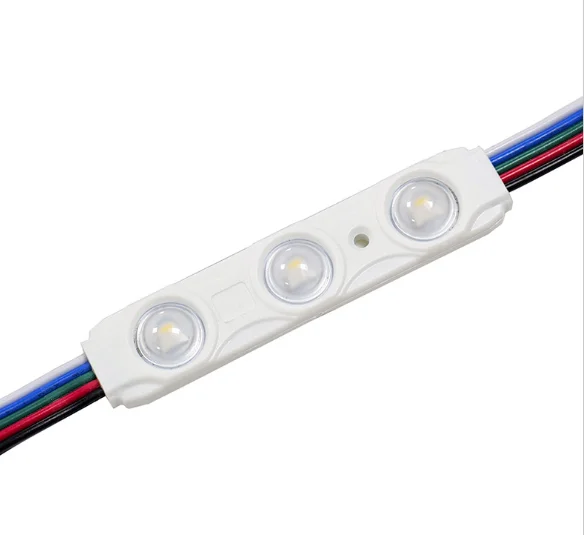
The 24V RGBW LED module rated at 0.96 W integrates three four-chip SMD5050 diodes (red, green, blue and white) in an IP67 overmoulded body with an aluminium base. Unlike a conventional RGB module, it includes a dedicated white channel, so it does not rely on additive mixing to produce white light: the result is a clean, stable white with a high colour rendering index (CRI ≥ 90), free from the bluish or pinkish casts typical of RGB-synthesised white. Available in pure white 6000K, neutral white 4500K and warm white 3000K, it lets you choose the daytime tone of the sign without giving up dynamic colour.
Technical advantages of the dedicated white channel in signage and channel letters
In illuminated signage the sign runs on corporate white most of the time and only occasionally in colour (campaigns, holidays, events). A pure RGB module has to drive all three channels at full power to approximate white, which means higher consumption, poorer uniformity and colour drift between batches. RGBW solves this: only the W channel is switched on for white mode (lower consumption and heat), keeping R/G/B for colour effects. The 160° lens spreads the flux widely and evenly, avoiding hotspots on acrylic or opal faces, and the IP67 body allows outdoor installation with direct exposure to dust and rain.
Power supply, wiring and sizing
It runs on 24 VDC constant voltage, halving the current compared with a 12 V system and allowing runs of up to 40 modules while keeping voltage drop below 5%. At roughly 0.04 A per module, a 100 W power supply comfortably feeds more than 90 units (always size with at least a 20% margin). Control requires a 4-channel RGBW controller/decoder (PWM or DMX512 depending on the project); every module in the line changes colour in sync.
Installation recommendations
For light boxes and channel letters 60 to 120 mm deep, the usual module spacing is 100–130 mm, adjusting density to the face thickness and the required luminance. Fix the modules with the factory-fitted 3M adhesive tape on a clean, degreased surface, respect polarity and wire everything with the power disconnected. In narrow letters, lay the modules out in a zigzag pattern to avoid shadows on the side returns.