LED Winery & Cellar Lighting: Protect Wine, Enhance Display
· Guías técnicas
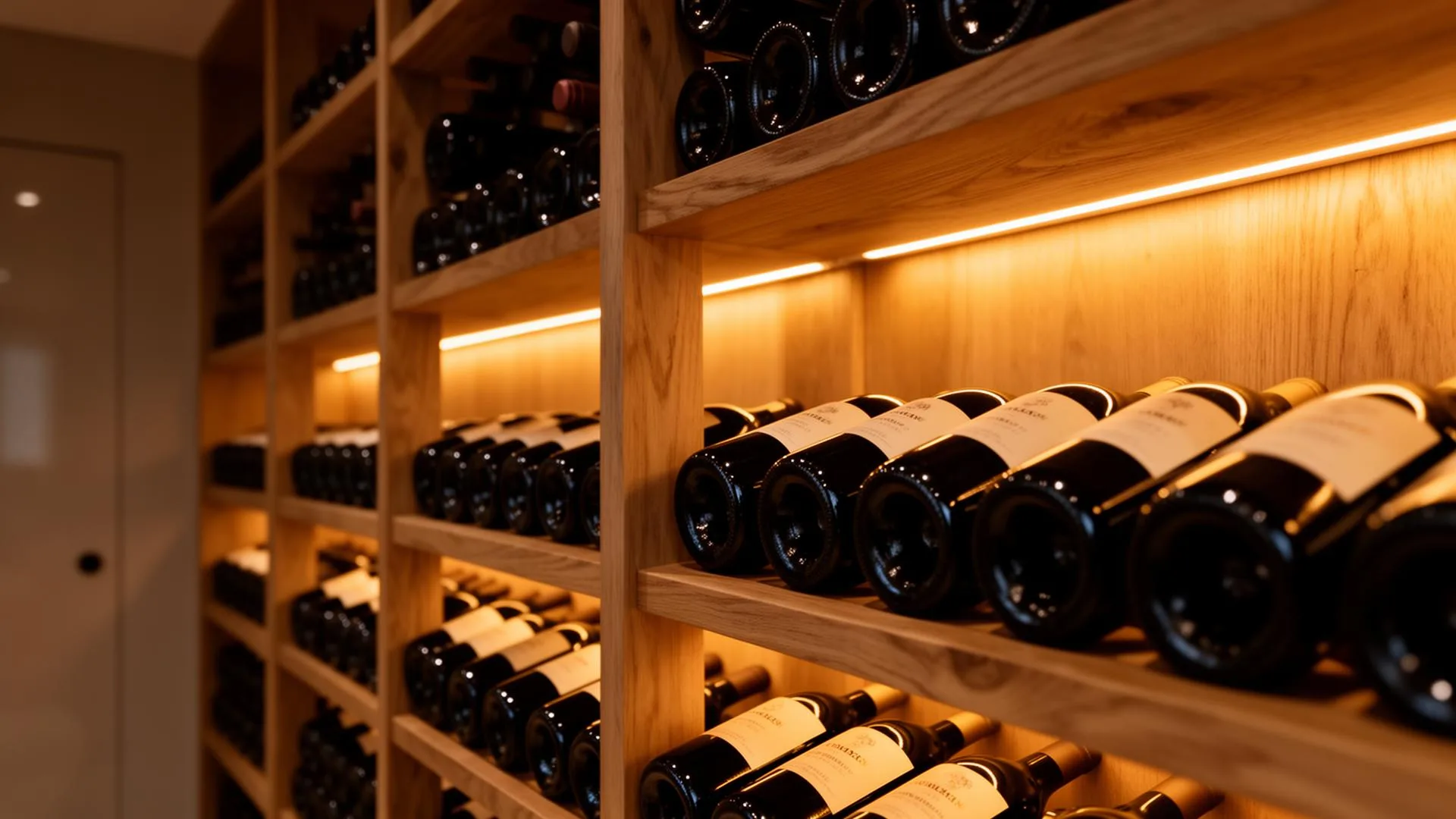
Lighting a winery or a wine cellar with LED is not a problem of lumens; it's a problem of spectrum. Wine chemically reacts to two things that light can provide without being perceived by the eye: ultraviolet radiation and high-energy blue light peaks. This is why a premium wine cellar should never be illuminated with halogen, fluorescent, or generic LED. The correct solution is 2700K warm white LED modules with CRI ≥ 90 and 0% UV emission, combined with night dimming and the correct installation geometry.
In 30 seconds
- · 0% UV: rule out halogen and fluorescent, use professional LED.
- · CRI ≥ 90 with R9 ≥ 50 (95 / R9 ≥ 80 for premium wine cellars).
- · CCT 2700K in display, 3000K in technical area.
- · 50–100 lux in storage cellar · 150–250 lux in commercial wine shop.
- · 24V for long runs; 0–10V or DALI dimming with night shutdown.
Illuminating wineries and wine cellars with LED involves providing visible light with CRI ≥ 90, warm color temperature (2700–3000 K), and zero ultraviolet emission, maintaining illuminance between 50 and 250 lux depending on use. This combination preserves the wine's aromatic compounds, prevents "light-strike," and respects the true color of labels and capsules. GP Trader meets this requirement with high-efficiency injected LED modules, verified CRI 90+, and a flat spectral curve in the 380–780 nm range.
1. Why does light damage wine?
Wine is a living chemical matrix. Light contributes energy to this matrix in two ways: photochemical (UV and violet break bonds) and thermal (infrared heats the liquid). In a bottle of red reserve wine, continuous halogen exposure at 300 lux for six months generates detectable sensory defects in professional tasting: aromas of cooked cabbage, wet cardboard, and loss of fruit. In white and sparkling wines, the effect is even faster because clear glass filters much less UV than green or amber glass.
The two critical wavelengths are UV-A (320–400 nm), directly responsible for light-strike, and high-energy blue light (HEV, 400–450 nm), which accelerates the oxidation of riboflavin and pantothenic acid. A good professional LED emits exactly zero between 320 and 380 nm and a moderate, controlled blue peak at 450 nm. A low-cost generic LED, however, can have a disproportionate blue peak that translates to white light to the eye but accelerates chemical oxidation.
2. Which CRI and R9 to choose for wine lighting?
The CRI (Color Rendering Index) measures how 8 standard colors appear under a light compared to sunlight. The problem is that the saturated red of red wine is not among those 8 colors: it corresponds to the R9 indicator, which is published separately and hardly anyone looks at. A CRI 80 LED can have a negative R9, which flattens red wine and makes it look earthy brown. That's why the technical rule for wineries and wine cellars is to always demand the complete spectral curve and both values: CRI ≥ 90 and R9 ≥ 50. For premium wine cellars, restaurants with visible cellars, or tasting rooms, elevate to CRI 95 with R9 ≥ 80.
| Use | Minimum CRI | Minimum R9 | Recommended CCT |
|---|---|---|---|
| Home cellar / private storage | CRI 80 | — | 2700 K |
| Commercial wine shop / retail aisle | CRI 90 | R9 ≥ 50 | 2700 K |
| Restaurant with visible cellar | CRI 90–95 | R9 ≥ 60 | 2700 K |
| Tasting room / sommelier training | CRI 95 | R9 ≥ 80 | 3000 K |
3. What color temperature (CCT) best enhances wine?
2700K is the standard for wine shop aisles and exposed cellars: warm light enhances reds and golden reflections of the glass, brings the true color of red wine closer to what a customer would see under classic halogen and creates the expected commercial atmosphere. In areas where more precision is needed —tasting, labeling, quality control— it goes up to 3000K, still warm but with better detail definition. Going up to 4000K or more would be a mistake: neutral or cool white light reduces saturation in reds, makes whites greenish, and breaks the perception of a premium product.
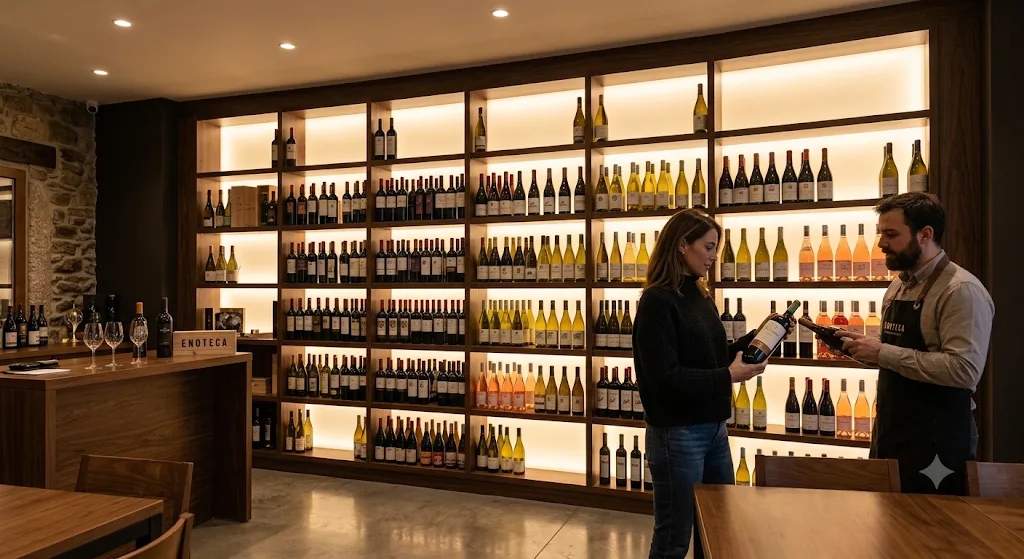
Recommendation
CRI 90+ LED Modules for Wineries and Cellars
High-efficiency, injected modules, warm white 2700K, zero UV emission, and IP67 certification for refrigerated cellars.
View warm white modules →4. How many lumens per shelf and how many lux on the bottle?
The practical rule is to work with target illuminance, not installed power. In a pure storage cellar, where the light is only turned on when someone enters, 50–100 lux measured on the front of the bottles is sufficient. In a commercial wine shop exposed to the public for 8–10 hours a day, the professional range is 150–250 lux. Only at tasting tables or labeling areas does it occasionally reach 300–500 lux, and always with dimming.
To achieve 200 useful lux on the front of an 80 cm deep shelf with high-efficiency 170 lm/W LED modules mounted on the upper edge, just 8–12 lumens per linear centimeter of shelf is enough. This is approximately equivalent to one or two high-efficiency 170 lm/W LED modules with CRI 90+ and 0% UV every 12–15 cm. Above 300 constant lux, oxidation accelerates even without UV; below 100 lux, the customer perceives the wine shop as "dark" and commercially poor.
5. 12V or 24V for LED modules in cellars?
In commercial wine shops with long shelves, several rows in series, and runs exceeding 5 meters, 24V is the professional option: for the same power, half the current flows, voltage drop is negligible, and a single driver powers 10–15 m of modules. 12V is reserved for individual showcases, small displays, or spot lighting of a single shelf (≤ 3 m). To properly size the driver and choose the appropriate safety factor, consult our technical guide for LED driver sizing with safety factor before finalizing the project.
6. How to mount the LED to avoid damaging the bottle or label?
The LED module or strip is installed hidden, indirect, and separated from the glass. Workshop recommendation:
- Aluminum profile under the upper shelf with an opal diffuser to eliminate hot spots and dissipate heat.
- Minimum 5 cm separation between module and bottle neck to avoid local thermal gradient.
- Grazing angle over the front of the label, never direct overhead on the capsule.
- IP67 in refrigerated cellars with condensation or relative humidity ≥ 70%.
- 0–10V or DALI dimming with scenes: 100% during business hours, 30% for cleaning, 0% at night.
7. Technical checklist before signing the project
- Zero active halogens and fluorescents in the space.
- Spectral curve of the LED published by the manufacturer with 0% UV < 380 nm.
- CRI ≥ 90 / R9 ≥ 50 verified (95 / R9 ≥ 80 in premium).
- CCT 2700K in display, 3000K in technical area.
- Target Lux calculated: 50–100 cellar, 150–250 wine shop.
- 24V voltage and Meanwell driver operating at 60–80%.
- Dimming and automatic night shutdown programmed.
If all seven points are resolved, the installation will protect the wine for years, maintain the commercial perception of the product, and reduce electricity consumption compared to an equivalent halogen solution by 75% to 85%.
Recommended catalog
Warm white 2700K LED modules, CRI 90+ and 0% UV.
Real stock, 3-year warranty, datasheet with spectral curve and R9 published.
View warm white modules →Frequently asked questions
Why should UV light be avoided in wineries and wine cellars?
Ultraviolet radiation (especially 300–400 nm) breaks chemical bonds in the aromatic and antioxidant compounds of wine, generating the so-called <strong>"light-strike"</strong>: aromas of cooked cabbage and wet cardboard detectable in professional tasting after 3–6 months of continuous exposure. It also oxidizes the pigments of white wine and discolors labels and capsules. Well-manufactured LEDs emit 0% UV below 380 nm, compared to halogen (1–3% UV) or fluorescent (5–7% UV).
What CRI do I need in a professional winery or wine cellar?
A minimum of <strong>CRI ≥ 90</strong> with R9 (saturated red) ≥ 50 so that red wine appears with its true nuances—ruby, garnet, brick—instead of the flat color given by CRI 80 LEDs. In premium wine cellars and tasting areas, the standard is <strong>CRI 95</strong> with R9 ≥ 80, equivalent to the color rendering of a halogen but without UV or radiant heat.
What color temperature (CCT) is correct for illuminating wine?
<strong>2700K</strong> is the standard for display areas, counters, and sales shelves: it enhances the red of red wine and creates a warm ambiance without distorting labels. <strong>3000K</strong> in technical areas (tastings, storage) where a little more definition is needed. Never use 4000K or higher: cool white dulls reds, makes whites greenish, and breaks the commercial perception of the product.
How many lux are recommended on bottles?
For storage (closed cellar or winery) <strong>50–100 lux</strong> maximum, only lit when accessed. For commercial wine shops open to the public, <strong>150–250 lux</strong> on the front of the bottle. Above 300 lux and with accumulated hours, even a UV-free LED can accelerate oxidation due to the blue component of visible light (HEV 400–450 nm), so 0–100% dimming and automatic night shutdown are recommended.
12V or 24V for LED modules in cellars or wine shops?
<strong>24V</strong> for long shelves, cellars with several rows, and chained commercial wine shops: for the same power, half the current flows, voltage drop is reduced, and a single driver powers sections of 10–15 m without issue. <strong>12V</strong> is reserved for individual showcases, small displays, or spot lighting of a single shelf (≤ 3 m).
Do LEDs generate heat inside a refrigerated cellar?
Yes, but very little compared to halogens or fluorescents: a 0.72 W LED module dissipates ~0.5 W thermally from the back. In a 200-bottle cellar with 30 high-efficiency LED modules, the thermal contribution is < 25 W, negligible compared to the door opening load. Even so, mount the modules on the ceiling or behind the shelf (never attached to the bottle neck) and combine with dimming to reduce the contribution when there is no observer.