LED modules for Stretch Ceilings: Distance & CCT Guide
· Guías técnicas
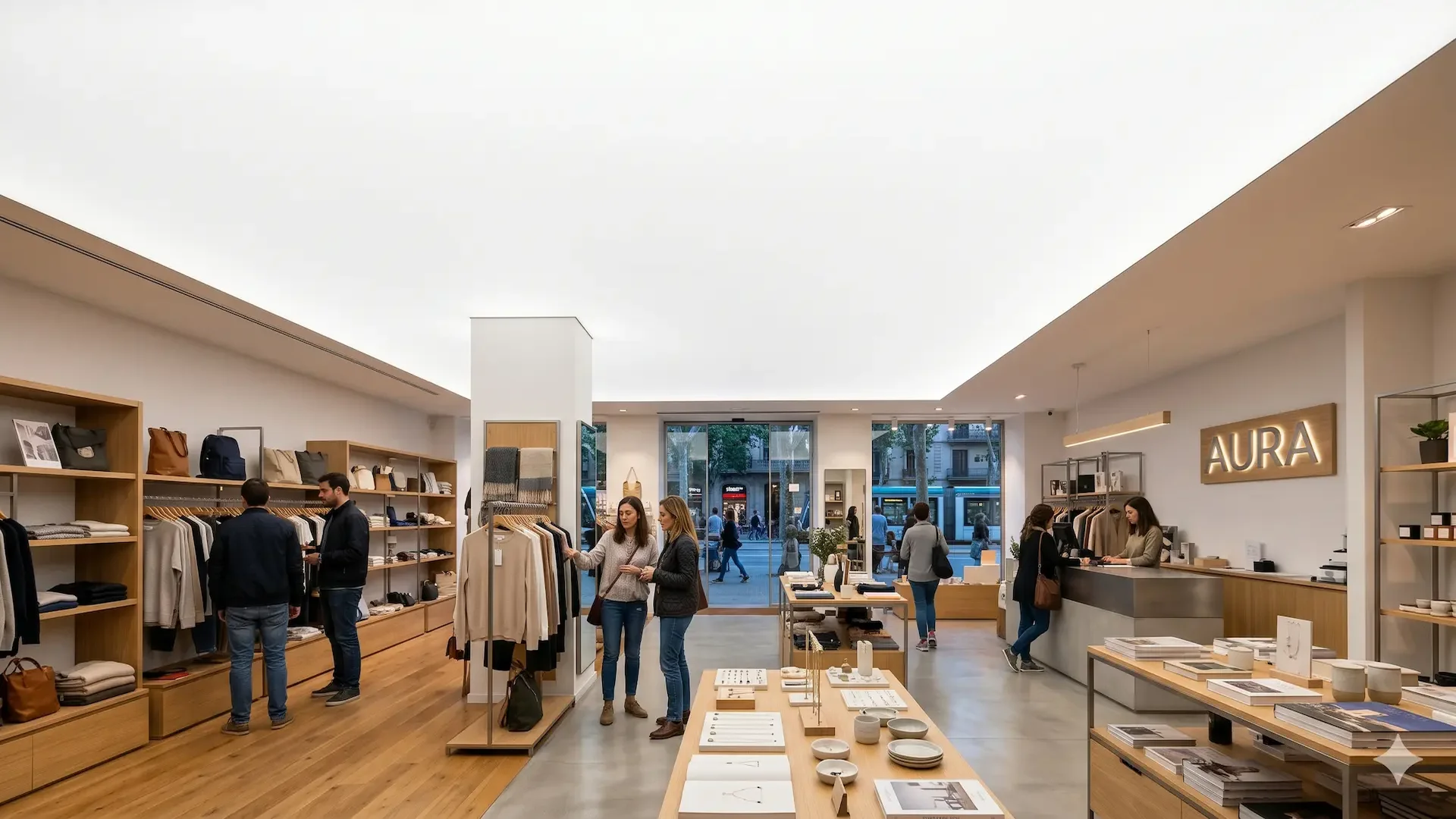
A well-executed backlit stretch ceiling looks like a sky: a continuous luminous surface, without dots or shadows, dimmable in intensity and temperature. Achieving this is not a matter of brand, but of three technical variables that almost no one publishes with real data: plenum depth, module pitch, and membrane CCT. This guide applies these three variables to high-efficiency 170 lm/W LED modules with 170° optics for large-surface backlighting and shows how to size a stretch ceiling from 1 to 30 m² without hot spots and with the driver operating in a safe zone.
In 30 seconds
- · Minimum plenum depth: 10 cm. Optimal: 15–20 cm.
- · Pitch between modules ≈ plenum depth (1:1 to 1:1.5 ratio).
- · Luminous density: 8,000–10,000 lm/m² for offices, 15,000+ for premium retail.
- · CCT: 3000K residential, 4000K office, tunable for architecture.
- · Voltage: 24V almost always; 12V only for details < 2 m².
1. How to illuminate a stretch ceiling: system anatomy
An illuminated stretch ceiling consists of three layers: a translucent PVC membrane stretched over a perimeter profile, a plenum (technical cavity between membrane and slab), and a lighting plane where the LED modules are anchored. The membrane acts as the final diffuser: it allows 38–45% of the light received from behind to pass through and hides individual dots if the mixing in the plenum is correct. If the mixing fails, the eye reads the matrix of LEDs as a visible dot pattern, especially when the light is dimmed.
Final quality does not depend on the isolated module, but on the geometric relationship between depth and pitch. Injected LED modules with 170 lm/W real efficiency and ABS V-0 certification allow for reducing the total number of points while maintaining lumens per square meter, which reduces driver costs and simplifies distribution over the slab.
2. Plenum depth: the master variable
Plenum depth (the useful distance between the module plane and the inner face of the membrane) determines how far apart the modules can be placed. Greater depth = light beams overlap more before touching the membrane = more uniformity. Shallower depth = cones do not mix, and hot spots appear.
| Plenum depth | Recommended use | Visual result |
|---|---|---|
| < 10 cm | Not recommended for surfaces > 1 m² | Visible dots even with modules at 5–8 cm |
| 10–12 cm | Decorative, low intensity, small format | Acceptable with pitch ≤ 10 cm and 170° module |
| 15–20 cm | Professional standard, office, and retail | Uniform with 15–20 cm pitch on both axes |
| 25–30 cm | Exhibition halls, lobbies, sky-effect | Allows pitch > 25 cm and deep dimming without dots |
3. Alternatives for shallow plenums: flexible LED sheets
When the architectural project imposes a plenum of less than 10 cm—whether due to a false ceiling with a very low metal structure, a renovation of an existing slab, or a backlit wall with minimal construction gap—point-source LED modules are no longer viable. In these conditions, the light cones do not have sufficient space to overlap before reaching the membrane, and the result is inevitable: a visible map of dots regardless of the density installed. The technical solution is not to force more modules into a narrow cavity, but to change technology and opt for 24V flexible LED sheets designed for narrow-space backlighting, which distribute light continuously rather than discretely.
LED sheets are flexible polyimide panels or similar substrates on which SMD diode arrays are arranged in a dense grid. Unlike point modules, which concentrate luminous flux at a point every 10–20 cm, the sheet emits from its entire surface, eliminating the concept of "pitch" and turning the source into a diffuse luminous plane. This has two decisive advantages in shallow plenums: the mixing distance no longer depends on depth, because the sheet itself works as a primary diffuser, and the stretch ceiling membrane receives uniform illuminance even at 4–6 cm separation. In practice, a stretch ceiling with a 6–8 cm plenum and a flexible LED sheet achieves the same homogeneity as an 18–20 cm plenum with discrete modules.
From an electrical standpoint, the flexible LED sheets in the GP Trader catalog operate at 24 VDC, maintaining consistency with the rest of the installation and allowing large surfaces to be powered from a single driver without critical voltage drops. The light output is around 2,000 lumens per sheet depending on the model and diode configuration, with densities exceeding 120 LEDs per unit. This is approximately 1,500–1,800 effective lm/m² once membrane transmittance is applied, sufficient for decorative environments, backlit signage, and residential areas where the objective is ambient light rather than task lighting.
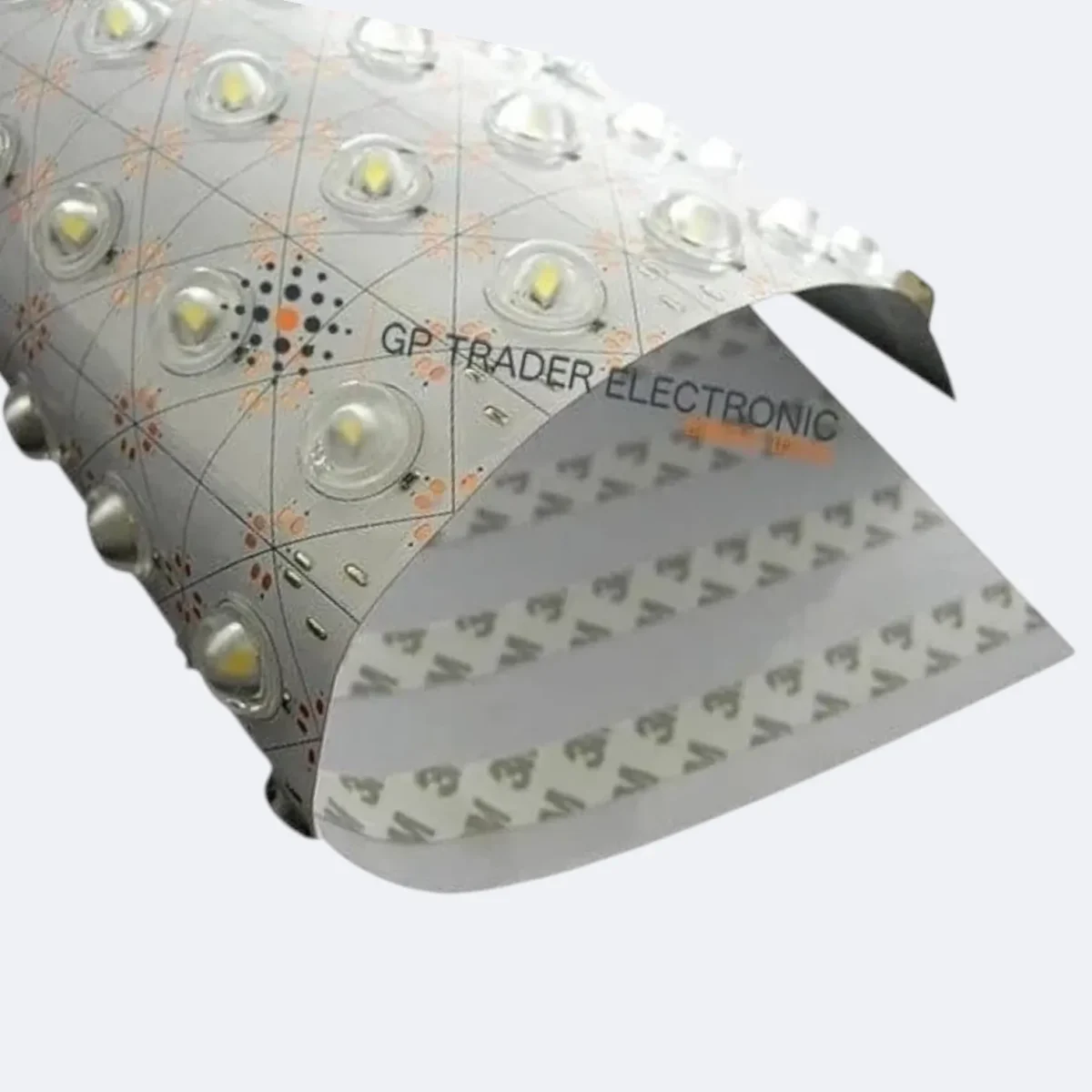
The installation in stretch ceilings or backlit walls with shallow plenums follows a different sequence than point modules. Instead of anchoring individual points on a metal profile, the sheet is fixed using thermally conductive double-sided adhesive or micro-screws to a clean, flat surface on the slab. The emissive face must be oriented towards the membrane. If the sheet is smaller than the surface to be lit, several units can be connected in parallel maintaining 24V polarity. In backlit walls or shop-window lightboxes, the sheets are distributed in a mosaic tile pattern, leaving 2–3 cm margins at the perimeter to avoid local overheating and allow for substrate expansion.
It is worth noting that flexible LED sheets, being an extensive area light source, generate more dissipated heat per surface than an isolated module, but this heat is spread over a much larger area. Nonetheless, in very closed plenums—less than 8 cm and without ventilation—it is advisable to leave a 1–2 cm air gap or use a low-profile aluminum support as a passive heatsink. The stretch ceiling membrane should be a high-diffusion translucent type (30–38% transmittance, not 45%) so that light spreads before crossing the PVC.
In summary: if the architect or installer faces a stretch ceiling or lightbox whose technical cavity does not allow for the minimum 10 cm depth, the correct decision is not to reduce the pitch of point modules to absurd limits, but to skip them and use 24V flexible LED sheets (2,000 lm) designed for narrow spaces. The paradigm shift—from point source to area source—solves the uniformity problem at the source, reduces assembly time, and avoids the risk of hot spots that ruin the finish of a premium stretch ceiling.
4. Distance between LED modules: pitch-to-depth ratio
The most useful technical rule in architectural signage: the distance between modules should be equal to or slightly greater than the plenum depth. Recommended ratio: 1:1 to 1:1.5 (pitch:depth). Below 1:1, material is wasted; above 1:1.5, dots reappear.
| Depth | Recommended Pitch | Modules per m² | Module Optics |
|---|---|---|---|
| 10 cm | 10 × 10 cm | 100 | 170° wide angle |
| 15 cm | 15 × 15 cm | 44 | 170° wide angle |
| 20 cm | 20 × 20 cm | 25 | 170° or 160° |
| 25 cm | 25 × 30 cm | 13 | 160° |
Working with 170° wide-angle optics modules is what allows this ratio to be maintained without penalizing uniformity. Generic modules with 120° openings force the pitch to be lowered by 25–30%, which proportionally increases material and wiring costs.
5. Luminous density: how many lumens per m² to deliver
The membrane absorbs between 55% and 62% of the light emitted by the modules. To deliver X visible lumens on the work plane, you must generate inside the plenum approximately 2.3× the final luminous power. This is the trap of projects that size "as if it were a panel": they end up with half the illuminance of the theoretical calculation.
| Application | Target Lux | Lumens/m² in plenum | Watts/m² |
|---|---|---|---|
| Decorative / Ambient | 100 lx | 3,000–5,000 | 18–30 |
| Residential / Hospitality | 150–200 lx | 5,000–7,500 | 30–45 |
| Office / Standard Retail | 300 lx | 8,000–10,000 | 47–59 |
| Premium Retail / Showroom | 500–750 lx | 15,000–20,000 | 88–118 |
Calculation based on LED modules with 170 lm/W real efficiency and 42% membrane transmittance. Switching to generic 110 lm/W modules penalizes wattage by 55% and increases driver costs and heat dissipation inside the plenum.
Recommendation
Calculate your stretch ceiling in less than a minute
Enter the surface area, plenum depth, and target light level to get the exact number of modules, the driver sized at 70%, and an optimal grid sketch.
Open the LED module calculator6. CCT: color temperature for stretch ceilings
The stretch ceiling is the largest luminous surface in the space. The CCT you choose sets the emotional tone of the entire room. An error here is more costly than in any other luminaire.
- 3000K (Warm White): Residential, hospitality, bedrooms, restaurants, spas. Softens skin tones and wood. It should be combined with a slightly warm membrane.
- 4000K (Neutral White): Offices, general retail, dental clinics, professional kitchens. The European standard for task lighting. It's the "safe" choice when there is no clear design brief.
- 5700–6500K (Cool White): Industry, warehouses, technical rooms, hospitals. Avoid in residential or retail settings unless there is a technical justification.
- Tunable White (3000–6500K): Premium architecture, showrooms, museums, and offices. Allows following the circadian cycle: warm at sunrise/sunset, cool at midday. Requires a dual-channel driver and DALI, 0-10V, or RF controller.
7. Voltage: why 24V almost always wins
For surfaces over 4–5 m², where total power exceeds 150–200 W, 24V LED modules with 170° optics become mandatory. Maintaining 12V at this scale requires multiplying drivers, heavy-gauge cables, and extra connection boxes:
- 12V — Only for small backlighting (< 2 m²), decorative islands, or shop windows. Voltage drop forces 2.5 mm² or higher cable for runs over 3 m.
- 24V — Professional standard. At equal power, half the current flows, which lowers voltage drop and allows 24V Meanwell power supplies with ripple < 5% and MTBF > 100,000 h to power zones of 8–12 m² from one point.
If you want to review the power supply calculation step by step, we have a technical guide for LED driver sizing with a safety factor covering the entire process.
8. Designer technical checklist
Before signing off on a backlit stretch ceiling budget, ensure you have answered these seven points:
- Real plenum depth measured on-site, not from the floor plan.
- Target Lux on the work plane (not in the plenum).
- Membrane transmittance chosen (38%, 42%, 50%).
- Module Pitch calculated with a 1:1 to 1:1.5 ratio vs. depth.
- CCT consistent with the space use.
- 24V Voltage and driver at 60–80% capacity.
- Matte white plenum and sealed (no dust or insects).
Regarding the plenum: the inner face of the slab must be painted matte white to reflect light escaping backwards. A dark plenum wastes 18–22% of the light. The perimeter must be sealed to prevent dust and insects from causing visible spots through the translucent membrane.
Next step
Ready to apply this to your project?
Our technical team helps you size the installation, choose the correct power supply, and quote materials in less than 24 hours.